Physical Change: Queensland floods, drought, cyclone, bushfire, Sydney Olympic Park
Socio-economic change: carbon tax, Mining Boom, Australian dollar, increased Toruism
Cultural Change: population growth, new prime minister, global warming, asylum seekers, increase of overweight people.
What are some of the ways that we can find out how Australia has changed in each of these categories? What research could we do to figure out how Australia has changed?
Queensland Floods:
One way we could find out how the Queensland floods has changed Queensland is by comparing pictures/videos of Queensland before the floods and comparing it to after the flood. The research we can conduct can include looking at different types of internet sites, such as Google maps and watching videos on the floods.
Population growth:
One way we can find out how this is changed is by conducting a census. This actually occurred recently. It is conducted every five years in which all members per house are accounted for by filling out a detailed questionnaire. Some of the questions ask refers to the person’s cultural background, socio-economic group, education statists.
Increase of overweight people:
One way we can find out the increase of overweight people is by counting the number of fast food restaurants in Australia in 1996, and comparing it to the number of fast food restaurants today. Another way we can find out about the increase of overweight people is by counting the number of overweight people in public hospitals in 1996 and comparing that number to the number of overweight people in public hospital’s nowadays. We can find this information by looking through various internet sites or getting statistics of overweight people at the public hospital.
For each of the THREE from above find an answer. Then write a paragraph about how you think the information you have found has led to change in Australia.
The Queensland flood has physically changed and this causes people from other states to become more helpful and concerned about their problem. People will join in communities to help clean up Queensland and donate goods to Queensland to help them with their problem. Because of the population growth, the government can review the Census and build more facilities that will fulfil people’s needs. The increase of overweight people has caused people to be concerned about their weight. More people are now going to the gym where they exercise to avoiding becoming overweight.
Wednesday, August 17, 2011

Saturday, June 18, 2011
Changing Australian Communities
Changing Australian Communities
1. What is a primary source when doing research? What is a secondary source? Which one is better? When do you use these types of sources?
Primary source is a term used to describe source material that is closest to the person, information, period or idea being studied.
A secondary source is a document or recording that relates or discusses information originally presented elsewhere.
The primary source is better as it is more reliable in researching and finding the correct information. You use these sources in subjects like history.
2. What is a primary source for finding population data for Australia? Why?
A primary source for finding population data for Australia would be the Australian Bureau of Statistics as it is a government website.
3. What is the population of Australia?
The population of Australia is about 22,640,229
4. What is the 'growth rate' of Australia for 2010?
The growth rate is 1.6 per cent growth
5. How many 'new' Australians were there in 2010?
It grew by 1.6%, 345000
6. How many of the 'new' Australians were born in Australia and how many are immigrants?
7. Which state had the greatest growth in population for 2010?
New South Wales
8. What changes have you noticed in your area that could be related to growth in population?
I’ve noticed that there are more Asians in my area which properly due to growth in population.
9. Is it good that Australia's population continues to grow?
It is not good as it means that Australia must increase our consumption of natural resources.
10. When, in history, has Australia NEEDED the population to grow? Why? Where did these people come from?
1. What is a primary source when doing research? What is a secondary source? Which one is better? When do you use these types of sources?
Primary source is a term used to describe source material that is closest to the person, information, period or idea being studied.
A secondary source is a document or recording that relates or discusses information originally presented elsewhere.
The primary source is better as it is more reliable in researching and finding the correct information. You use these sources in subjects like history.
2. What is a primary source for finding population data for Australia? Why?
A primary source for finding population data for Australia would be the Australian Bureau of Statistics as it is a government website.
3. What is the population of Australia?
The population of Australia is about 22,640,229
4. What is the 'growth rate' of Australia for 2010?
The growth rate is 1.6 per cent growth
5. How many 'new' Australians were there in 2010?
It grew by 1.6%, 345000
6. How many of the 'new' Australians were born in Australia and how many are immigrants?
7. Which state had the greatest growth in population for 2010?
New South Wales
8. What changes have you noticed in your area that could be related to growth in population?
I’ve noticed that there are more Asians in my area which properly due to growth in population.
9. Is it good that Australia's population continues to grow?
It is not good as it means that Australia must increase our consumption of natural resources.
10. When, in history, has Australia NEEDED the population to grow? Why? Where did these people come from?
Thursday, June 2, 2011
Monday, May 9, 2011
2.5 Tropical Cylcones
2.5 Tropical Cyclones
1. What are tropical cyclones?
A localized, very intense low-pressure wind system, forming over tropical oceans and with winds of hurricane force.
2. Where do tropical cyclones occur?
They occur in tropical regions of the world.
3. Name the areas of Australia most at risk from tropical cyclones.
They occur over the northern areas of Australia. They generally affect areas north of Perth along the coasts of Western Australia and the Northern Territory, most of the Queensland coastline and occasionally the far north coast of New South Wales.
4. How many tropical cyclones are expected to cross the Australian coastline each year?
Six
5. What are some other names for tropical cyclones?
Hurricanes or typhoons.
6. Complete the passage below.
Tropical cyclones develop in the tropical regions of the world. Heat from the sun causes warm, moist air to rise into the atmosphere. As the air rises, a low pressure system forms and condensation occurs, which releases latent heat causing the air to rise further into the atmosphere. If the air pressure in the upper atmosphere is high, then the rising column of warm air will spiral outwards in the upper atmosphere and air will rush from the surface to replace it, forming a tropical cyclone.
7. What is the eye of a tropical cyclone?
Is a region of mostly calm weather found at the centre of strong tropical cyclones.
8. Draw an annotated diagram to show the main features of a tropical cyclone.
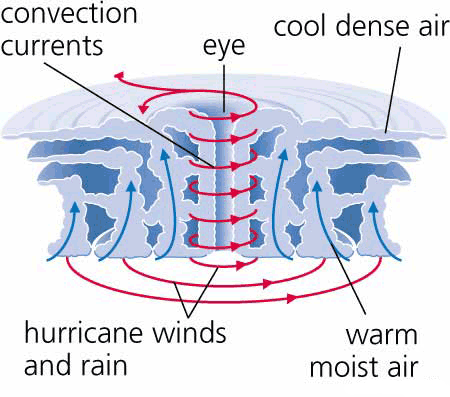
9.
What causes a tropical cyclone to be downgraded to a tropical storm?
When the warm, moist air is no longer present.
2.8 Studying the Weather
2.8 Studying the weather
1. Refer to synoptic chart and satellite image in 2.33 and 2.34:
a)
i. Hobart: 1016
ii. Port Hedland: 1010
iii. Melbourne: 1014
iv. Perth: 1018
b) Name a capital city that will most likely experience rain in the next 12hours
Port Hedland would probable experience rain in the next 12 hours.
c) Prepare a brief weather forecast for Melbourne for the next 24 hours.
Melbourne would be experiencing a fine and sunny day with a clear sky for the next 24 hours. The air temperature is quite high generally meaning it will have stable conditions
d) Name the feature shown on the synoptic chart that has caused the cloud cover at the following locations:
i. Cold fronts
ii.
e) Hobart because it has a higher pressure
2.2 Landslides, earthquakes and tsunamis
2.2 Landslides, earthquakes and tsunamis
1. What is a landslide?
A geological phenomenon which includes a wide range of ground movement, such as rock falls, deep failure of slopes and shallow debris flows, which can occur in offshore, coastal and onshore environments.
2. Describe the main causes of landslides.
Heavy rainfall saturating the soil, vibrations from earthquakes or undercutting of banks and cliffs from waves or rivers.
3. In what way can human actions contribute to landslides?
Construction of roads and railways on hillsides along with building works can weaken hillsides and make them more vulnerable during heavy rainfall.
4. What are earthquakes and how are they measured?
Earthquakes are intra-plate tension where movements occur along cracks and faults in the Earth’s crust. Earthquakes are measured in magnitude.
5. What is the main cause of earthquakes in Australia?
The main cause of earthquakes in Australia is inter plate tension
6. How frequently does Australia experience earthquakes of 5.5 on the Richter scale and why do they usually have minimal impacts on communities?
Every 15 months
7. List the impacts of the 1989 earthquake on the Newcastle community.
13 people were killed and more than 120 people were injured
8. Describe the difference between a landslide and an earthquake.
Earthquakes are bigger and effect more people.
9. What is a tsunami?
A earthquake, landslide or volcano occurs under the sea.
10. Name three events that will cause a tsunami.
Earthquakes, landslide or volcano
Earthquakes, landslide or volcano
11. With the aid of a diagram, explain how a tsunami is formed
Sudden shifting of continental places causes earthquakes forcing sea water above to rise, forming waves.
Sudden shifting of continental places causes earthquakes forcing sea water above to rise, forming waves.
12. Describe three tsunami warning signs.
Shake, drop and roar
Shake – feeling an earthquake or the ground shake in a coastal area
Drop – the seal level will recede dramatically
Roar – often a tsunami can be heard
13. What caused in Indian Ocean tsunami of 2004
An undersea earthquake measuring a magnitude of 9.3.
14. How many earthquake monitoring stations are there in Australia? How long did it take for the India Ocean earthquake of 2004 to be picked up by one of these stations?
There are 23 stations in Australia and it took 20 minutes.
There are 23 stations in Australia and it took 20 minutes.
15. Describe how a tsunami changes as it enters shallow water.
As waves near land they slow to about 45kph, they squeeze upwards, getting taller.
16. What steps has the United Nations taken to safeguard Indian Ocean communities from the tsunami hazard?
The United Nations created the tsunami warning system
17. Who is Ted Bryant? What warning does he issue in regard to tsunamis for Australia?
Ted Bryant is a Wollongong university geoscience professor. He predicted that a tsunami will come soon because every 500 or so years a tsunami occurs in the alpine fault line.
18.
a) 95 E, 5 N
b)
ii. India: 2 hours
iii. Africa: 7 hours
iv. Australia: 5 hours
v. Tasmania: 9.5 hours
Saturday, April 30, 2011
2.1 natural hazards in Australia
2.1 Natural Hazards in Australia
1. What is a natural hazard?
A threat of a naturally occurring event that will have a negative effect on people or the environment.
2. What is the difference between a natural hazard and a natural disaster?
A disaster is something that have happened. A hazard is something waiting to happen.
3. What two broad categories of natural hazard exist in Australia?
Drought and heatwave
4. Make a list of the types of natural hazards that fit each category.
5. Why are natural hazards that occur in densely populated areas more noticeable that hazards that occur elsewhere in Australia
Because the impacts they have on communities are obvious and costly which becomes well documented and covered by the media because of the effects on a large number of people.
6. Outline two specific impacts droughts have on rural communities in Australia
Economic impacts and environmental impacts
7. Name the three categories geographers use to classify the impacts of natural hazards. Give examples of each.
1. Social impacts – tsunami
2. Economic impacts – droughts
3. Environmental impacts – floods
8. Explain why it is essential that Australian communities study the nature and impacts of natural hazards.
So they can plan responses and determine better ways for communities to survive the threat of living with natural hazards.
9. Explain how GIS is used to map the threat of natural hazards in Australia.
Gis uses data to predict the areas where natural hazards are most likely to occur. Using 2573 postcodes from across Australia and data on the number of times a natural hazard has occurred in the particular postcode area. It shows the potential risk from nine different hazards.
10. Refer to 2.4 and the text
a) Tropical cyclone
b) Tropical cyclone
11. Make a list of the ways the information in 2.3 would be useful to the following groups:
a) So they know if they are located where natural hazards occur
b) So they know where about natural hazards may occur
c) Build more emergency services around places where natural hazards occur
d)
Subscribe to:
Posts (Atom)